

Pakistani businesses often lag in AI business automation due to limited technical awareness, misconceptions about costs, shortage of skilled employees, weak digital infrastructure, and reliance on manual workflows.
However, with better adoption of AI to automate businesses in Pakistan, businesses can reduce repetitive work, improve response times, and increase overall productivity.
But it is not just a matter of buying AI tools. Businesses also must have connected systems, usable data, clear workflows, and people who understand how to leverage AI and human intelligence in tasks.
What is AI Business Automation?
AI business automation combines artificial intelligence with software workflows to complete business tasks with limited manual input. Unlike basic automation, AI can also interpret information, identify patterns, generate responses, and support decisions.
A manual sales process may involve:
- Receiving a lead through a website form.
- Copying the details into a spreadsheet.
- Assigning the lead to a salesperson.
- Sending a follow-up email.
- Setting a reminder for another follow-up.
- Updating the sales record after every interaction.
Why Pakistani Businesses Are Behind in AI Business Automation
1. Lack of AI Awareness
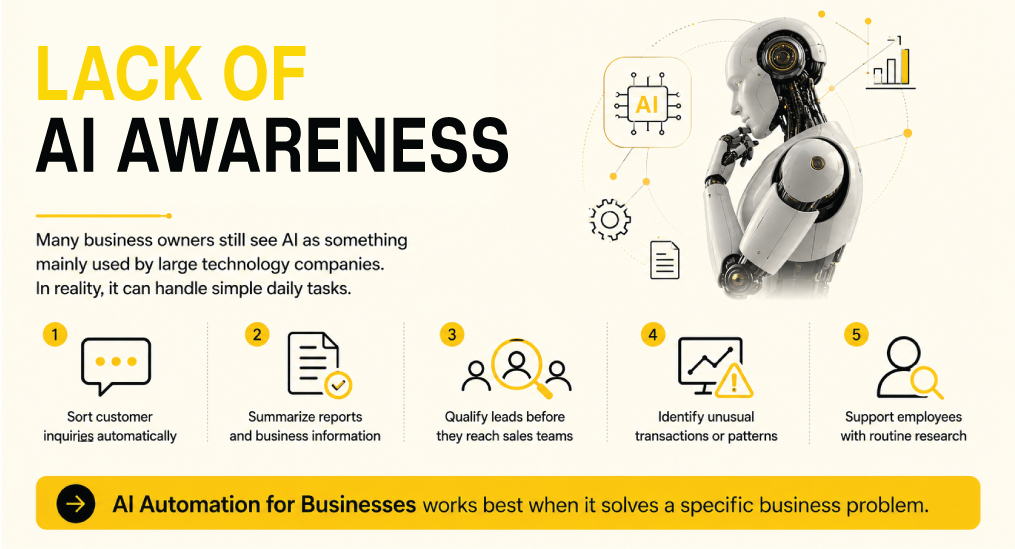
Many business owners still see AI as something mainly used by large technology companies. In reality, it can handle simple daily tasks.
- Sort customer inquiries automatically
- Summarize reports and business information
- Qualify leads before they reach sales teams
- Identify unusual transactions or patterns
- Support employees with routine research
AI Automation for Businesses works best when it solves a specific business problem.
2. Resistance to Change
Many companies still depend on familiar manual processes. Changing them can feel risky, even when they take up valuable time.
- Teams remain dependent on spreadsheets and emails
- Employees repeat the same tasks every day
- Manual approval steps slow down workflows
- New technology may feel difficult to adopt
- Businesses often prefer familiar processes
Starting with one simple workflow can make the change easier.
3. Limited Digital Infrastructure
AI needs connected systems to work properly. Unfortunately, many organizations still operate with disconnected software and scattered information.
Customer data may exist across multiple platforms, websites may not connect with CRM systems, and employees often move information manually between applications. Older software can also make integration difficult.
A connected digital environment creates the foundation needed for effective automation.
4. Poor Data Management
AI relies on clean and organized data. When customer records are duplicated, outdated, or scattered across spreadsheets, automation becomes less reliable.
Many businesses in Pakistan still maintain separate customer lists for sales, marketing, and finance, resulting in inconsistent information.
Organizing records, standardizing data, and improving access controls significantly increases the effectiveness of automation initiatives.
5. Shortage of AI Expertise
Having access to AI tools does not automatically mean a business knows how to use them effectively.
Many organizations struggle to identify which processes should be automated first.
Employees may lack practical AI skills, teams may find system integration challenging, and businesses sometimes invest in tools without clearly defined objectives.
Success depends on identifying repetitive, time-consuming tasks where automation can create measurable improvements.
6. Budget Misconceptions
Many business owners assume AI requires massive investments, preventing them from exploring smaller and more practical automation projects.
In reality, automation can begin with a single repetitive task, allowing businesses to test results before expanding. Costs vary depending on existing systems, available data, and the level of customization required. Productivity improvements can be measured early, making future investment decisions easier.
The right starting point is rarely the most expensive solution.
7. Fear of Job Replacement
Some employees worry that automation will make their roles unnecessary.
In practice, it can remove repetitive work and give teams more time for valuable tasks.
- Employees spend less time entering repetitive data
- Routine questions can be handled automatically
- Reports can be prepared with less manual work
- Teams can focus more on customers and decisions
- Human judgment remains important for complex tasks
The goal is to support employees, not remove the human role from business.
How AI & Business Automation Can Increase Productivity
1. Save Time
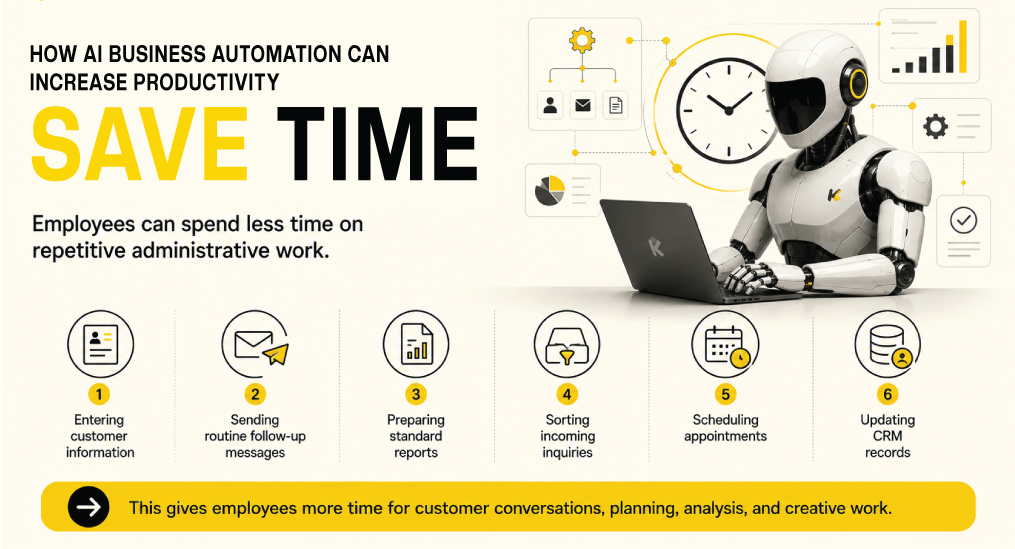
Automation allows employees to spend less time on repetitive administrative work and more time on activities that directly contribute to business growth.
Routine tasks such as entering customer information, sending follow-up messages, preparing standard reports, sorting inquiries, scheduling appointments, and updating CRM records can all be automated.
Instead of handling paperwork, employees can focus on customer conversations, planning, analysis, and creative work.
2. Reduce Human Errors
Repetitive manual work naturally increases the chance of mistakes.
Automating processes such as invoice processing, inventory updates, customer data entry, expense tracking, and report generation improves consistency while reducing costly errors.
3. Increase Sales
Sales teams benefit when routine administrative work is automated.
Lead capture, qualification, CRM updates, follow-up emails, and sales reminders can all happen automatically, allowing sales representatives to spend more time closing deals instead of managing spreadsheets.
4. Improve Customer Support
AI can respond instantly to common customer questions while support teams focus on more complex requests.
Businesses can automate FAQs, order updates, appointment bookings, live chat responses, and ticket routing, providing faster service without increasing staff.
5. Better Decision-Making
Modern AI systems help businesses turn large volumes of information into useful insights.
Instead of manually reviewing spreadsheets, managers can quickly understand sales trends, customer behavior, inventory performance, demand forecasts, and operational reports.
6. Lower Operational Costs
Reducing repetitive manual work lowers operating costs over time.
Tasks such as data entry, payroll processing, invoice handling, email management, and report creation require fewer employee hours, allowing businesses to use resources more efficiently.
AI Solutions Every Pakistani Business Should Consider
Different departments can use AI in different ways. The right choice depends on the company’s workflow, data, systems, and goals.
| Business Area | AI Solution | Benefit |
| Customer Support | AI chatbots | 24/7 customer service |
| Sales | CRM automation | Better lead management |
| Marketing | AI content & email automation | Faster campaigns |
| HR | AI recruitment tools | Faster hiring |
| Finance | Invoice & expense automation | Fewer manual errors |
| Operations | Workflow automation | Higher productivity |
Workflow Automation is particularly useful when a process involves several people, systems, or approval steps.
For example, a new sales inquiry could automatically move from a website to a CRM, then to a salesperson, followed by a scheduled follow-up.
For businesses that communicate heavily through messaging, WhatsApp Automation Pakistan can also support customer notifications, FAQs, order updates, and other routine interactions.
Why Pakistani Businesses Should Start Now

The strongest reason to start is not that every company needs the newest AI technology.
It is that manual workflows become more expensive as a business grows.
A practical starting process looks like this:
- Identify a repetitive task.
- Measure the time it currently consumes.
- Check the quality of the available data.
- Select the appropriate automation approach.
- Test it with a limited workflow.
- Measure time saved, errors, and business results.
This approach makes AI adoption more controlled and easier to evaluate.
For example, a local distributor in Lahore managing 100 customer inquiries each week may handle them manually without difficulty. However, once inquiries increase to 1,000 per week, the same process quickly becomes a bottleneck unless automation is introduced.
The same applies to sales leads, invoices, employee records, inventory updates, and marketing campaigns.
Businesses should also avoid treating AI as a one-time technology project.
McKinsey’s State of Organizations 2026 report shows how organizations are increasingly using technology and AI to rethink workflows, improve productivity, and transform how work gets done.
Conclusion
AI Business Automation can help companies:
- Save employee time
- Reduce manual errors
- Improve customer responses
- Support better decisions
The opportunity is especially relevant for startups and growing companies.
They can build efficient workflows early instead of adding layers of manual work as they expand.
The goal is not to replace humans. It is to understand the debate between AI vs human intelligence.
So, AI should also remain a human-supported system. Employees still provide context, judgment, creativity, and accountability.
