
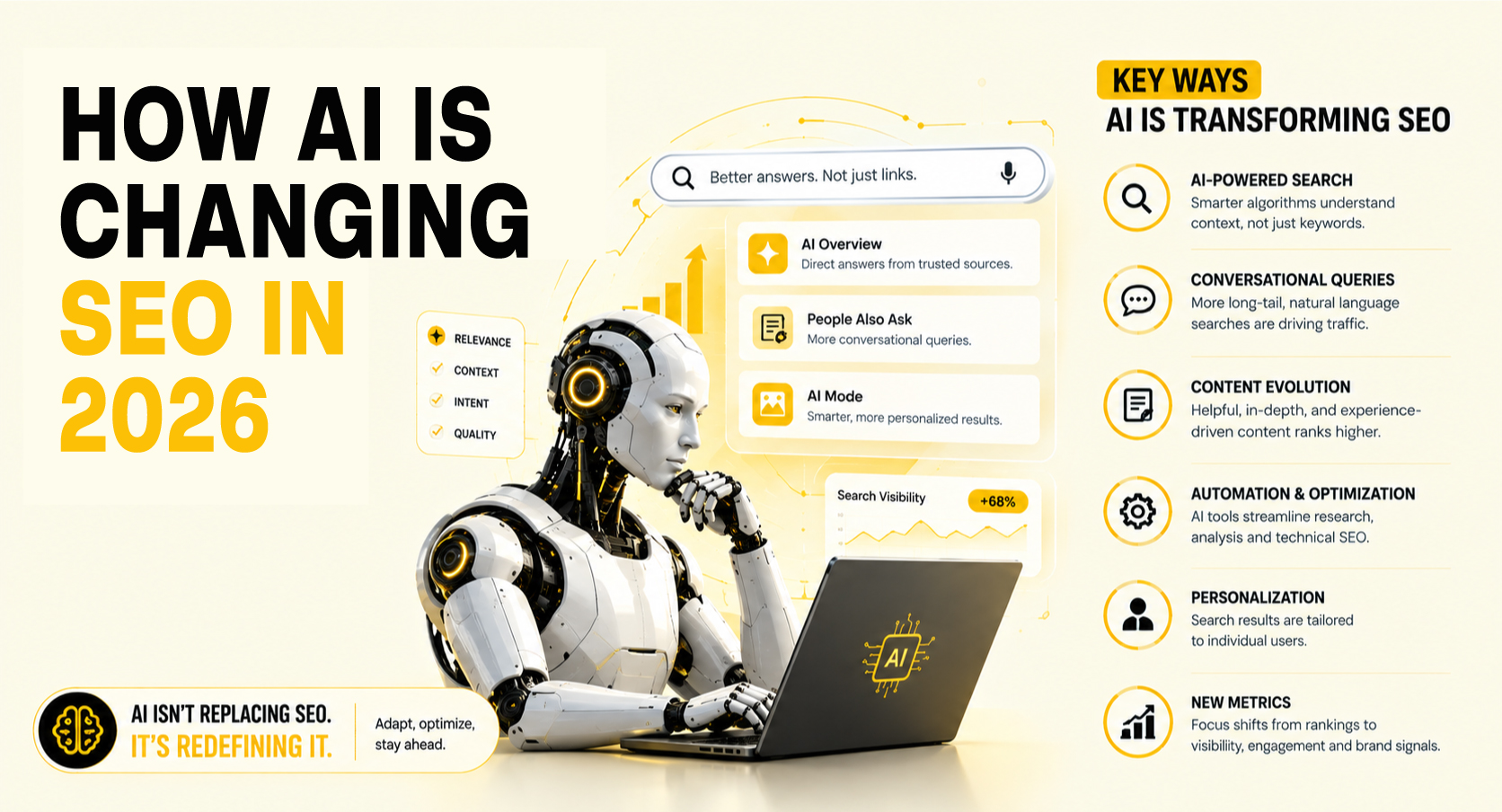
Search is no longer limited to typing keywords and choosing a blue link. AI now helps understand questions, connect concepts, summarize information, and surface relevant sources. This is how AI is changing SEO.
In 2026, search visibility depends on more than exact keyword matches. Search systems increasingly consider meaning, context, entities, content quality, and user intent when deciding which information is useful.
For Pakistani businesses and marketers working in the digital marketing field, the focus should be on understanding people and topics rather than simply placing keywords on a page.
What Is AI SEO?
AI SEO is simply search engines utilizing artificial intelligence to improve search visibility.
What AI SEO Does
The main focus of AI search optimization is analyzing the intent behind the content and helping websites rank in modern search results.
It includes using AI tools for keyword research, competitor analysis, content planning, technical audits, search-intent analysis, and content optimization.
Difference Between AI SEO & Traditional SEO
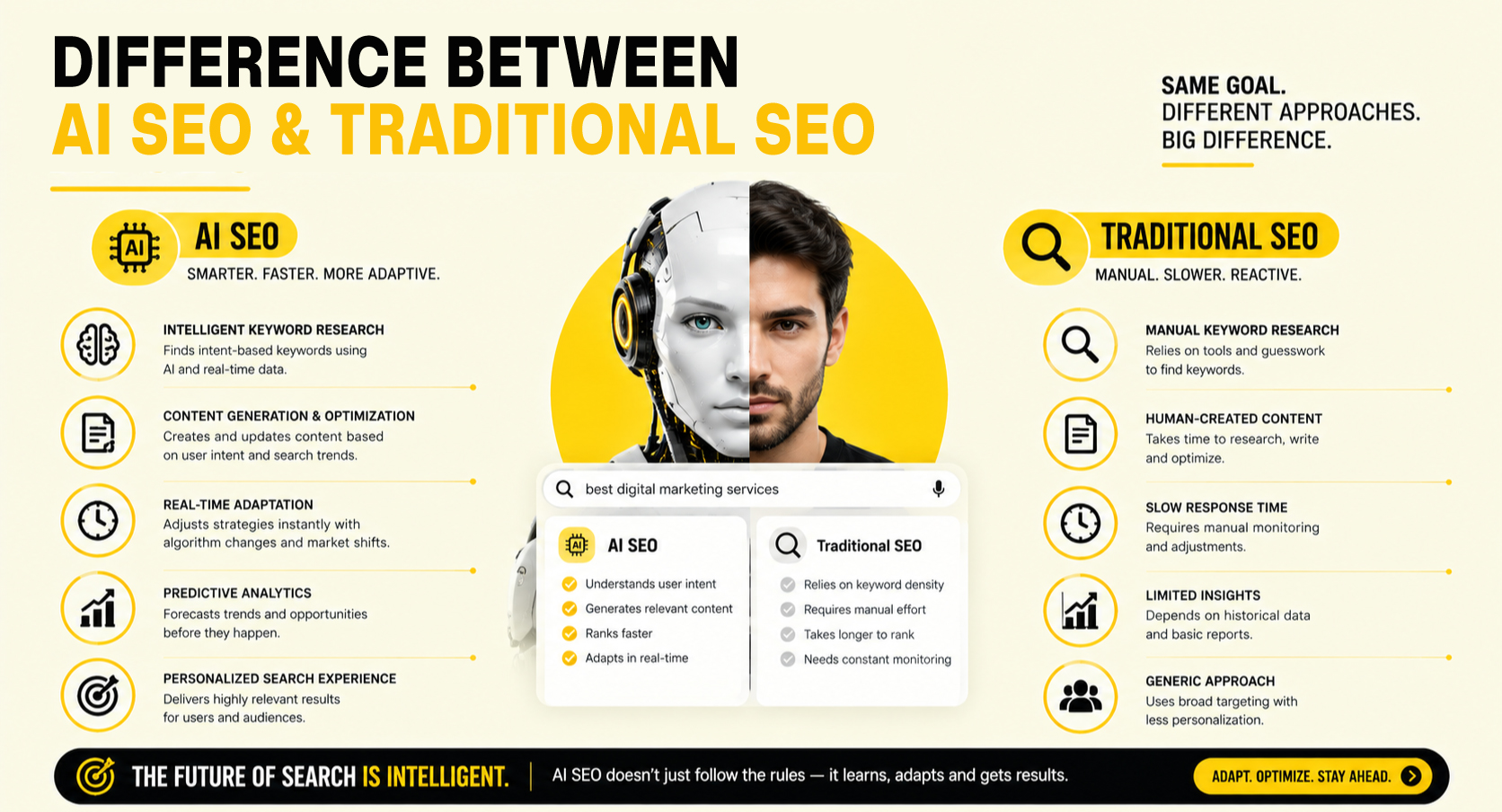
| Feature | Traditional SEO | AI-Focused SEO |
| Main Approach | Keyword targeting | Search-intent targeting |
| Search Visibility | Rankings | Visibility across search experiences |
| Content Focus | Individual keywords | Topics, entities, & relationships |
| Search Results | Blue links | Answers, summaries, & citations |
| Authority Building | Backlinks | Authority + trustworthy references |
| Content Optimization | Text optimization | Information optimization |
| Technical Focus | Search engine crawling | Machine understanding |
But this does not make human expertise any less important. What actually matters is understanding the difference between AI vs human intelligence to decide where automation ends, and human judgment begins.
How Is AI Changing SEO in 2026?
In 2026, search systems have leveraged AI to understand what users actually want.
This is why Google’s current guidance for generative AI search also strongly emphasizes unique, useful content, strong technical foundations, and information that provides value beyond what is already widely available.
1. AI-Driven Search Algorithms
Traditional search engines used to match keywords, but modern search systems can actually process language and context at a much deeper level.
They can consider factors such as:
- Natural-language processing helps systems understand complete questions.
- Search intent helps identify what the user actually wants.
- Contextual relevance connects a query with the surrounding information.
- Entity recognition helps identify people, places, products, and organizations.
This shift means a page can be relevant to a query without repeating the exact phrase dozens of times.
2. Semantic Search & User Context
Semantic search focuses on meaning rather than isolated words.
For example, someone searching for “best laptop for graphic design students” may also need information about display quality, RAM, graphics performance, software compatibility, and price.
This is the part where human expertise still outshines. Semantic SEO plays a major role in semantic AI search.
For that, your content must be surrounded by a topic covering important concepts rather than treating related phrases as a separate keyword.
Strong topic coverage can include:
- Entities and concepts connected to the main subject
- Context and meaning behind a search
- Topic clusters covering related questions
- Topical authority developed across multiple pages
- Content depth that directly serves the reader
3. Voice & Conversational Search
People mostly use voice search options rather than typing in their queries.
Instead of searching “digital marketing course Karachi,” someone may ask, “What digital marketing skills should I learn to get a job in Karachi?”
This creates greater importance for conversational search and question-based content.
Effective pages can address:
- Question-based searches
- Conversational keywords
- Search intent & Long-tail queries
- Featured snippet opportunities
- Local search queries
The goal is not to write every possible question. It is to answer relevant questions clearly when they genuinely help the audience.
4. AI-Generated vs Human-Edited Content
Another thing AI has brought to the SEO world is speed. AI can be utilized for research, outlining content, and content production.
But this does not make the final content useful.
Because the focus should still remain on quality, originality, experience, expertise, and value, which AI does not produce.
A strong workflow combines:
- AI-assisted content creation
- Human expertise and experience
- Fact-checking and accuracy
- E-E-A-T signals
- AI content quality control
So the advice for marketers would be to use AI business automation to support the process, but make sure the finished page contains information that could not have been produced by simply summarizing existing pages.
5. Automated Keyword and Competitor Analysis
A keyword tool might tell you that several searches are related. An SEO strategist still has to decide whether those searches represent the same audience need or deserve separate pages.
They can help identify:
- Search intent clusters
- Keyword difficulty patterns
- SERP patterns & topic opportunities
- Competitor content gap analysis
- Related entities and terms
This makes research more efficient. Human review is still needed to decide which opportunities fit the business, audience, and conversion goals.
6. Predictive SEO Strategies
SEO teams are also using AI to identify patterns before a topic becomes highly competitive.
Predictive workflows can examine:
- Search trend forecasting & Emerging topic identification
- User behavior & predictive keyword analysis
- Seasonal search patterns
- Competitor movement tracking
This can help marketers plan content earlier instead of waiting until competitors have already covered a subject.
7. Multimodal Search
Search is increasingly able to work across different content formats.
A user may discover information through text, images, video, or voice rather than through a traditional text query alone.
For marketers, this means SEO should not be treated as a text-only activity.
How Modern Search Engines Are Using AI
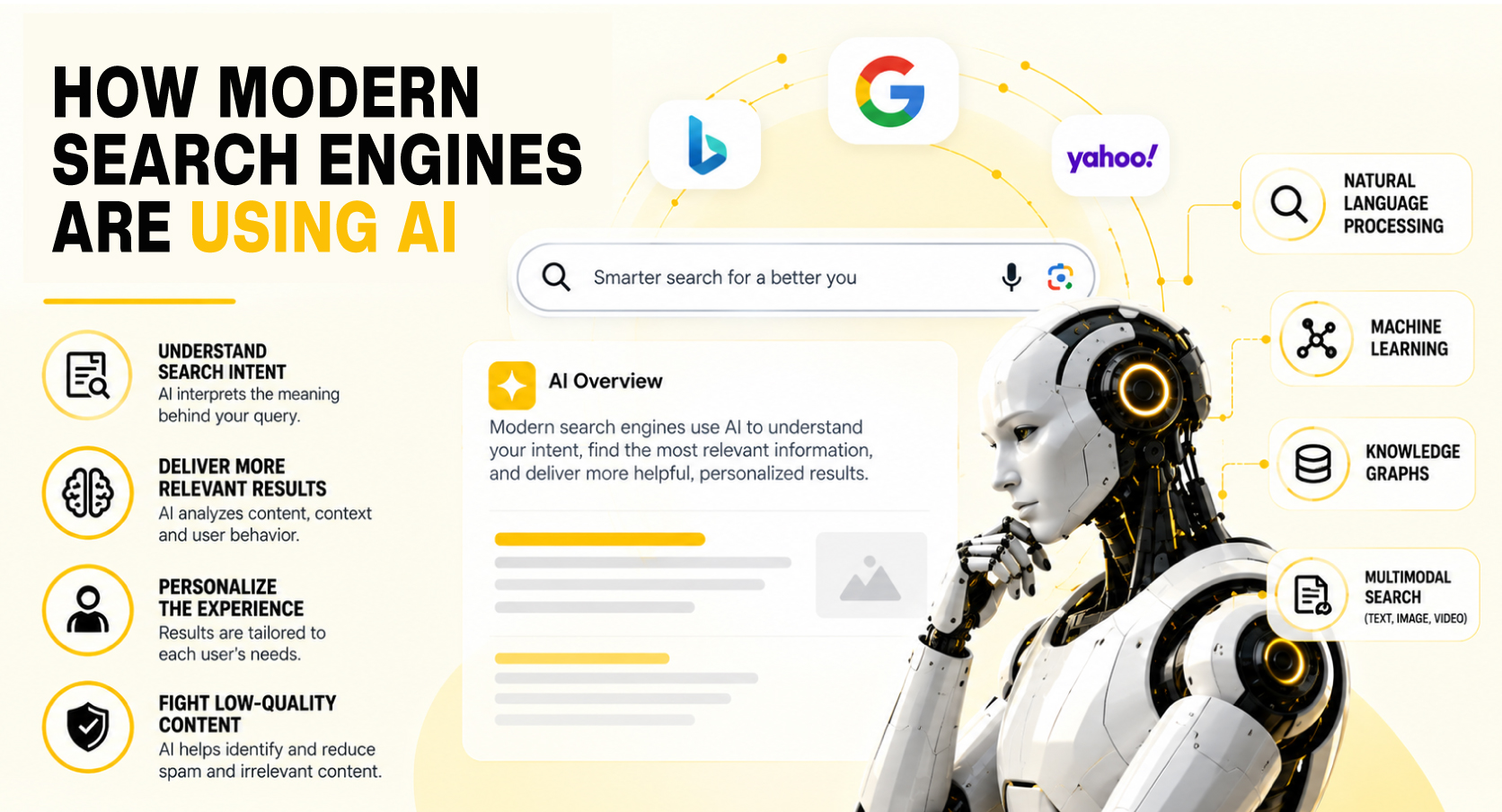
AI is now involved in several parts of the search process. Search systems need to understand queries, identify relevant information, assess content, and present useful results.
Key applications include:
- Natural Language Processing (NLP): Understands language, phrasing, and meaning.
- Intent Classification: Helps determine the purpose behind a search.
- Entity Recognition: Connects queries with identifiable people, places, brands, and concepts.
- Quality Scoring: Helps systems evaluate relevance, usefulness, and content quality.
- AI Overviews: Google’s AI-generated search feature can provide synthesized answers with supporting links when appropriate.
Google also notes that AI Overviews and AI Mode can use different systems and may show different responses and links.
Does Technical SEO Still Matter?
Yes. AI search does not remove the need for a technically accessible website.
Google says pages need to be indexed and eligible for Search before they can appear as supporting links in AI Overviews or AI Mode. There are no separate technical requirements specifically for AI features.
Important technical areas include:
- Crawlability
- Indexability
- Site architecture
- Internal linking
- Page speed
- Mobile usability
- Canonicals
- XML sitemaps
- Structured data
- JavaScript rendering
- HTTPS
- Core Web Vitals
Google’s Core Web Vitals measure loading performance, responsiveness, and visual stability. They remain part of the broader page experience picture.
How AI Is Transforming SEO Workflows
The use of AI and SEO in 2026 is changing how teams perform everyday tasks. It is becoming less about replacing keywords and more about avoiding repetitive keywords.
1. AI for Keyword and Topic Research
AI can organize research around related questions, search intent, topic gaps, sub-topics, long-tail queries, and conversational queries.
This makes it easier to build a content plan around one subject instead of creating disconnected articles.
2. AI for Competitor Analysis
AI can compare competing pages to identify:
- Content gaps & SERP patterns
- Topic coverage
- Competitor positioning
- Internal-link opportunities
3. AI for Content Optimization
AI-powered SEO workflows can support:
- Content briefs, structures, and references
- Search-intent analysis
- Semantic relevance
- FAQs
The final content still needs editorial review. Google’s guidance specifically warns against producing large amounts of low-value content primarily to manipulate search visibility.
4. AI for Technical SEO
AI can also help identify:
- Crawl issues
- Broken links
- Redirect problems
- Indexing anomalies
- Large-scale website audit issues
For large websites, this can save significant time during technical audits.
What AI Cannot Replace in SEO
Some parts of SEO depend heavily on human judgment and real-world knowledge.
These include:
- Human expertise
- First-hand experience
- Original research
- Brand reputation
- Trust
- Strategic decision-making
- Relationship building
- Quality backlinks
- Expert review
- Understanding customers
AI can identify patterns. It cannot independently know what a company’s customers actually experienced unless people provide that information.
How to Adapt Your SEO Strategy for AI Search in 2026
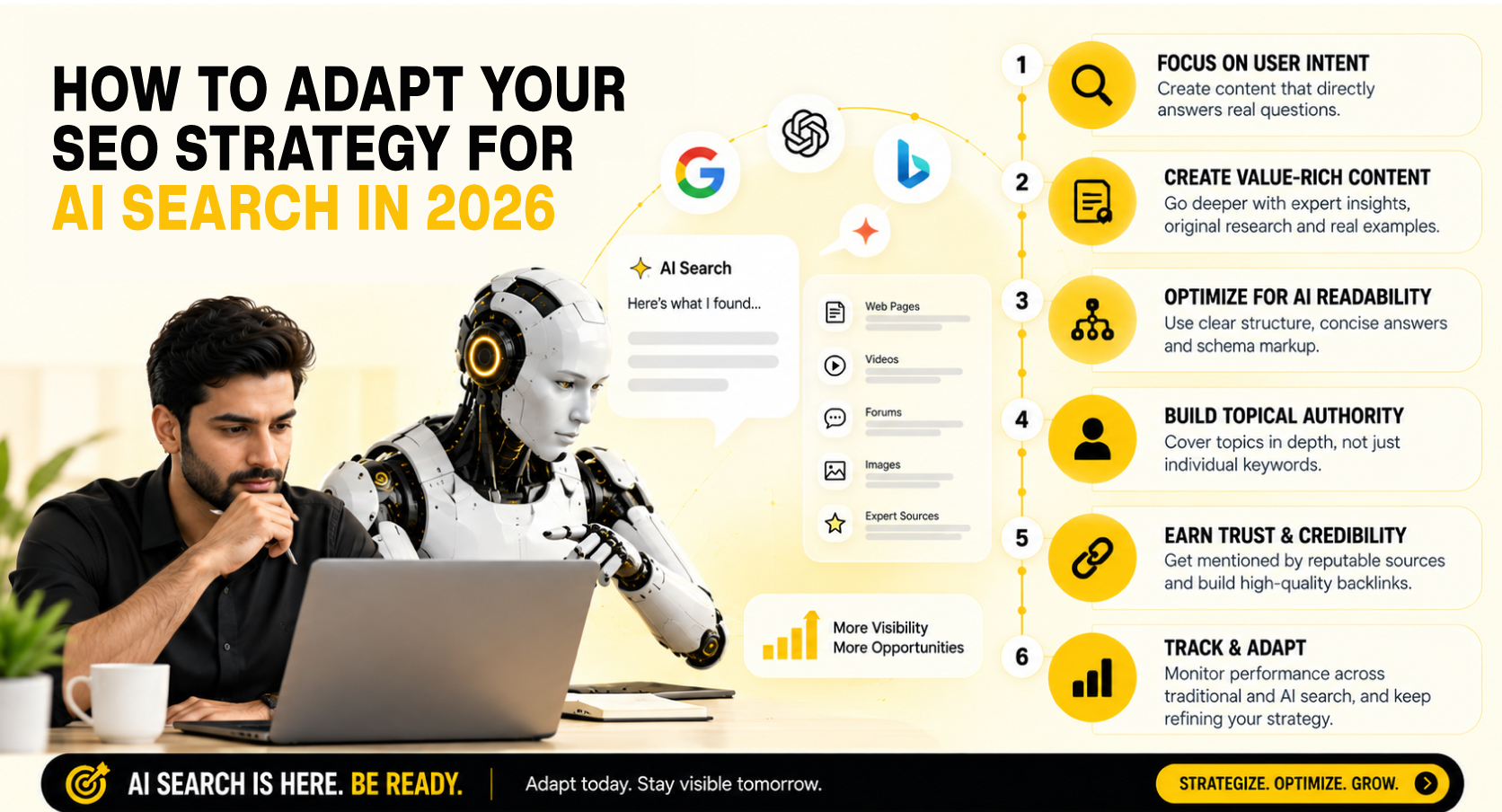
1. Build Topic Authority
Create connected content around important subjects rather than publishing unrelated keyword pages.
Cover the main topic, supporting questions, practical examples, and related subtopics.
2. Answer Questions Directly
Give users the answer early.
Use short explanations before expanding into details. This structure also makes important information easier for search systems to process.
3. Optimize for Entities and Context
Keep important information consistent across your website.
Use consistent:
- Brand information
- People
- Products
- Services
- Locations
- Industry terminology
This creates clearer signals about what your business does and where it operates.
4. Strengthen First-Hand Expertise
Add information that generic content cannot easily reproduce.
Consider:
- Original examples
- Case studies
- Expert opinions
- Customer experiences
- Proprietary data
This gives content a stronger reason to exist.
5. Make Content Easy for Machines to Understand
Clear structure benefits both readers and search systems.
Use:
- Clear headings
- Short paragraphs
- Lists
- Tables
- Definitions
- FAQs
- Descriptive anchor text
- Appropriate structured data
The objective is clarity, not creating content specifically for an algorithm.
6. Build Brand Authority Across the Web
Visibility does not come only from your own website.
Useful areas include:
- Digital PR
- Relevant backlinks
- Industry publications
- Reviews
- Social presence
- Business directories
- Consistent brand information
These activities can strengthen how a business is represented across the wider web.
7. Measure More Than Rankings
Rankings are still useful, but they do not tell the whole story.
Modern SEO KPIs can include:
- Organic traffic
- Impressions
- CTR
- Branded searches
- Conversions
- Assisted conversions
- AI referral traffic where measurable
- SERP visibility
- Featured snippets
- AI-result visibility and citations where measurable
Google introduced dedicated Search Console reporting for visibility within generative AI features, including AI Overviews and AI Mode, with the rollout reaching websites worldwide by August 31, 2026.
What AI-Powered SEO Means for Pakistani Businesses
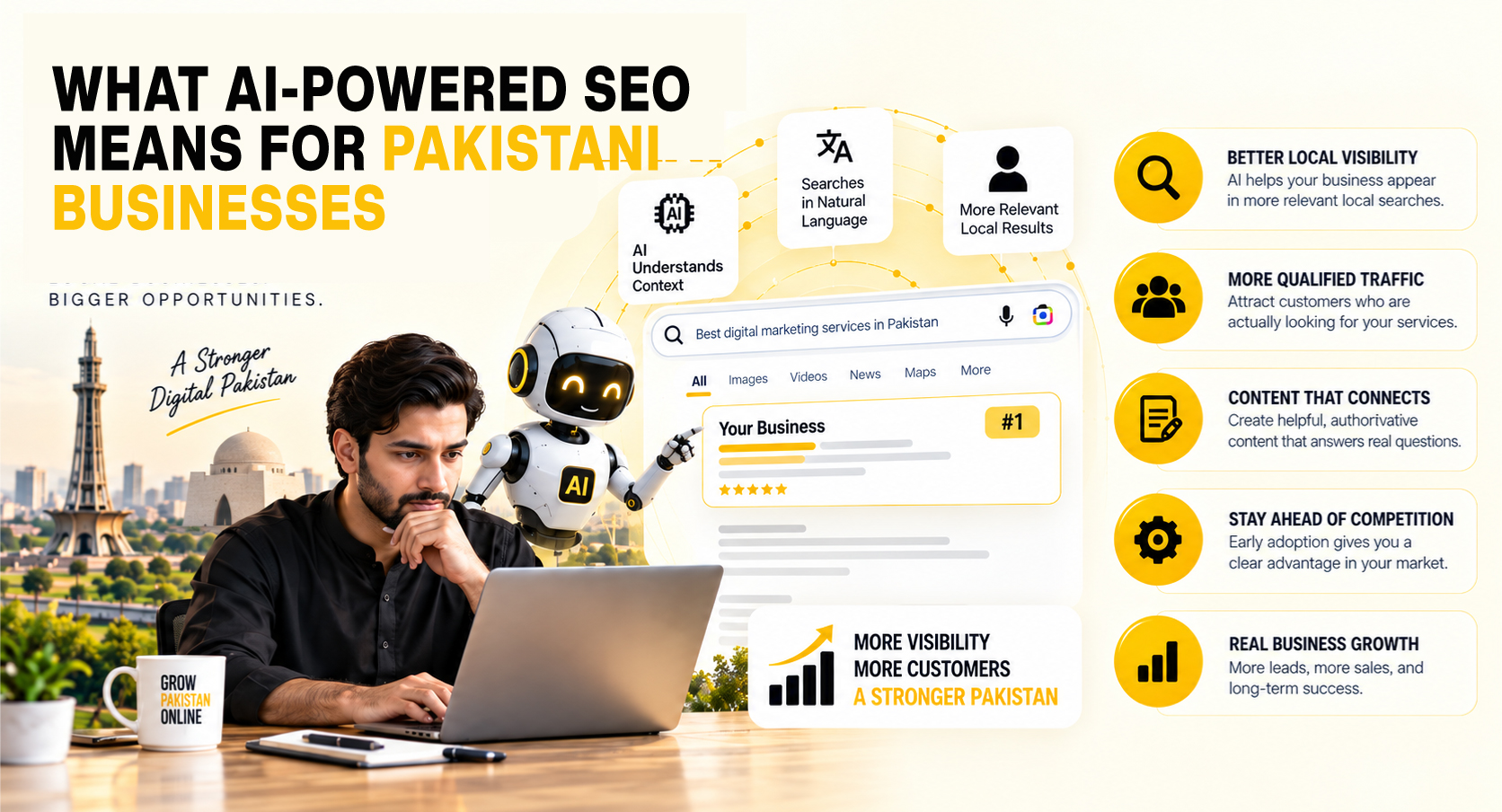
For Pakistani businesses, the shift toward AI search creates opportunities to compete through stronger local relevance.
1. Optimize for Local Search Intent
Local searches often include specific cities, services, and business needs.
Examples include:
- “best digital marketing agency in Karachi”
- “SEO agency in Lahore”
- “digital marketing services in Pakistan”
- “best SEO company in Islamabad”
The content should answer the actual local need instead of simply adding a city name to a generic page.
For example, the Pakistani brand Guy Knows Food has identified a gap in the local food market by introducing products such as kimchi, pickles, sauerkraut, and other fermented foods that are not commonly available in Pakistan.
Its main keywords include “best fermented foods in Pakistan”, “Gut-friendly foods in Pakistan”, and others related to the “in-Pakistan” searches.
2. Build Strong Local Entities
Businesses should keep information consistent across key platforms.
Focus on:
- Consistent NAP information
- Google Business Profile
- Local landing pages
- Reviews
- Local citations
- Pakistani business directories
- Relevant local backlinks
Consistency makes it easier for search systems and customers to understand the business.
Consistent local information also supports WhatsApp Automation by helping businesses maintain clear, reliable details across customer touchpoints and respond to local queries more effectively.
3. Create Content for Pakistani Searchers
Local context can make content more useful and distinctive.
Consider including:
- Pakistani market conditions
- Local consumer behavior
- PKR pricing where relevant
- Local examples
- Industry-specific Pakistani challenges
- Karachi, Lahore, or Islamabad search intent where appropriate
For example, National Foods used its “Karachi Khaas” campaign to target Karachi specifically, positioning its Bombay Biryani mix around the city’s distinctive taste and food culture rather than using the same generic messaging nationwide.
A Pakistani audience may have different budgets, buying habits, business challenges, and search behavior from audiences in the US or UK.
For students and job seekers, this also changes the skills worth learning. Keyword research still matters, but so do search intent, content strategy, analytics, technical SEO, AI tools, and critical thinking.
What Is the Future of SEO in 2026?
In the future, the debate is not about choosing sides between AI and traditional search optimization.
Rather, it is about building strong technical foundations with useful, original, and well-structured information.
AI is definitely changing how search engines understand queries and analyze content. But that does not mean that the fundamentals of AI search optimization are any different than traditional SEO.
The focus is still on creating useful content, understanding your audience, maintaining a sound website, and building genuine authority.
If you want to understand where your website currently stands and where there is room to grow, talk to our SEO team today and discuss opportunities to grow your search results.
